Film lab & scanning
From closed canister to editable files
From exposed roll to editable files — development chemistry, careful handling, scan resolution choices, and how digital deliveries return to you.
What happens after you shoot
- Intake — Rolls arrive labeled with your name and any notes about push/pull or cross-processing experiments. Staff log frame count and condition of canisters.
- Darkroom handling — Cassettes open only under safelight or in total darkness. Leaders are checked for snapped film or loose backing paper on medium format.
- Processing — Color negative runs through calibrated chemistry with temperature control; black-and-white may follow a separate line with timed agitation. Staff log chemistry batches and agitation timing for each run.
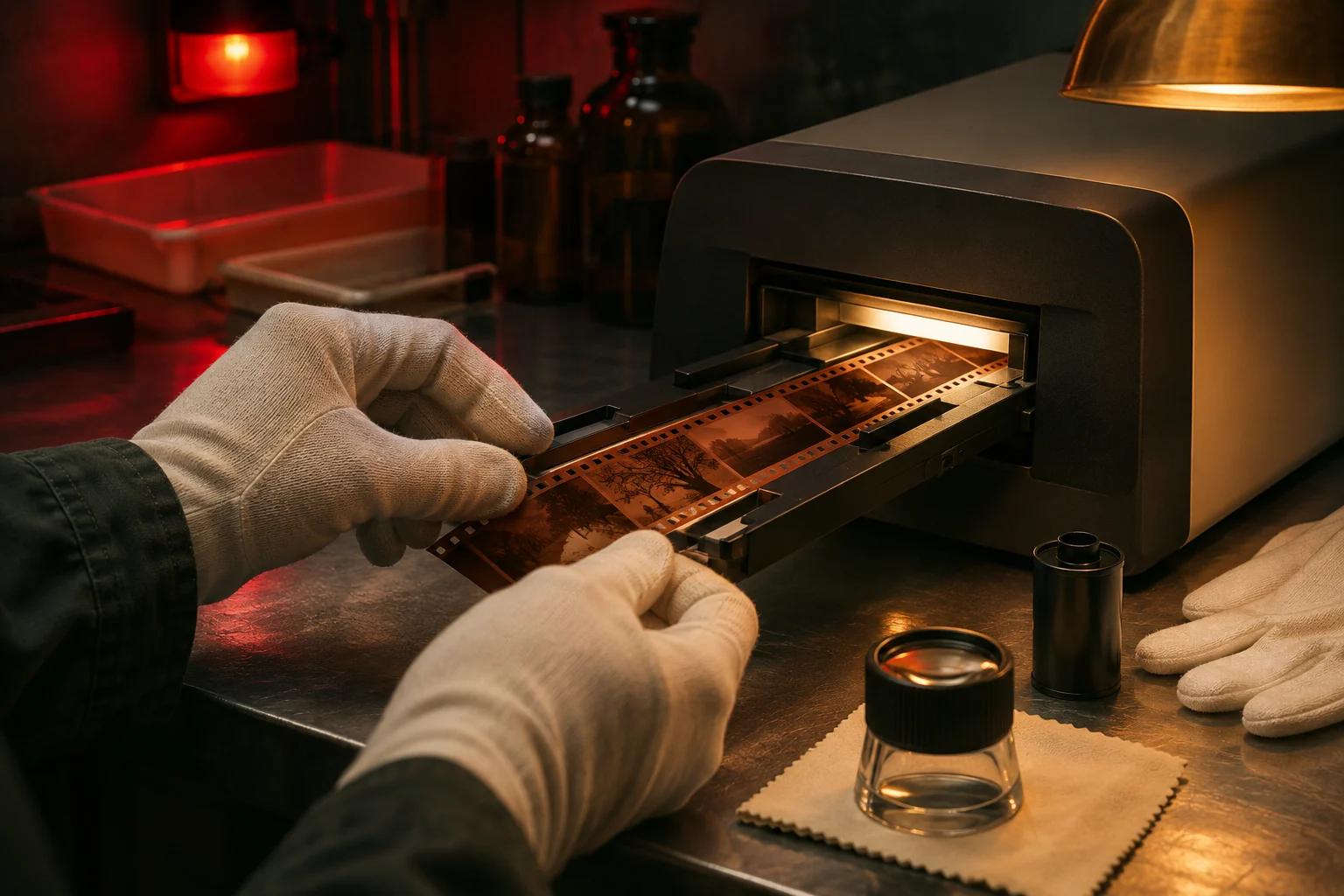
- Dry & cut — Negatives dry in dust-managed cabinets, then are sleeved or spooled with gloves to avoid oil transfer.
- Scanning — Flatbed or dedicated film scanners capture frames at resolutions you select — web-sized proofs versus archive masters with room to crop.
- Delivery — Files arrive as downloads or portable drives according to what you arranged at drop-off; negatives can ship back in parallel when requested.
Scan choices that matter
Resolution is not vanity — it is crop headroom and grain rendering. A modest scan suits social sharing; an archive pass preserves emulsion texture for enlargements.
- Bit depth — More data in shadows when scanners support it.
- Color profile — Labs may embed profiles so home monitors start closer to accurate.
- Dust spotting — Automatic removal helps; critical work may still want manual retouch.
Handling you can mirror at home
Keep rolls cool and dry before drop-off; note airport X-ray policies when you travel. At pickup, sleeve negatives promptly and store scans in at least two places if they matter to you.